Though set for any device, a laptop/tablet for a better experience is advised. See all HR resources could take a few minutes depending on your internet.
Thursday, December 9, 2010
Wednesday, November 17, 2010
Wednesday, November 10, 2010
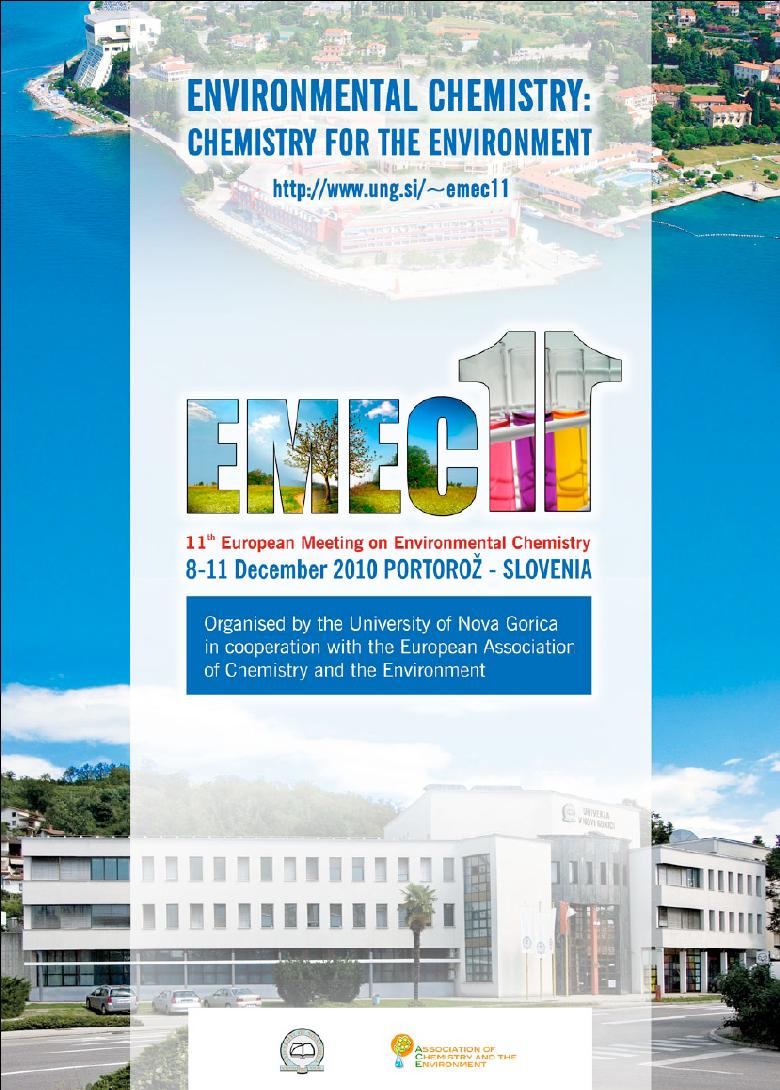
11 European Meeting on Environmental Chemistry, December-2010
8-11 December 2010. Portoroz-Slovenia
Organized by the Universtiy of Nova Gorica in cooperation with European Association in Chemistry and Environment
- atmospheric chemistry,
- soil chemistry,
- aquatic and marine chemistry,
- photochemistry and photocatalysis,
- biodegradation and bioremediation,
- ecotoxicology and biomarkers,
- emerging contaminants,
- waste water and solid waste treatment,
- analytical methods for environmental science and biomonitoring,
- pollution and cultural heritage,
will be covered within the conference keynote, oral and poster sessions.
Further information here
AGU Chapman Conference on Source to Sink Systems Around the World and Through Time
Recent Advances in Understanding Production, Transfer, and Burial of Terrestrial and Marine Materials on the Earth Surface
Oxnard, California, USA
24–27 January 2011
24–27 January 2011
Más información aquí
Wednesday, October 27, 2010
28th IAS MEETING OF SEDIMENTOLOGY Zaragoza, Spain 5th – 8th July, 2011
INVITATION
The International Association of Sedimentologists (http://www.iasnet.org), the Department of Earth-Sciences of the University of Zaragoza (http://wzar.unizar.es/acad/fac/geolo/) and the Geological Society of Spain (http://www.sociedadgeologica.es/) are happy to invite participants to the 28th IAS Meeting of Sedimentology, to be held in Zaragoza (Spain), on 5th – 8th July, 2011. The site of the meeting will be the Conference Centre of the Boston Hotel, located in the centre of the city of Zaragoza (http://www.hotelboston.es).
VENUE
Zaragoza (http://www.zaragoza.es) is currently the fifth biggest city in Spain and has 650,000 inhabitants. It is the seat of the Government of Aragón (http://www.turismodearagon.com) and is a modern city, which since the sixties has grown considerably. The strategic location of Zaragoza in the centre of northeast Spain makes it an ideal place for conferences, because it lies in the centre of the Madrid-Barcelona and Bilbao-Valencia axes.
Zaragoza can be reached by airplane from several European cities landing at the local airport (http://www.zaragoza-airport.com). There is also a regular connection by high-speed (“AVE”) trains from Barcelona and Madrid (http://www.renfe.es/ave).
Zaragoza was founded in the year 24 BC by the legions that had taken part in the Cantabrian Wars, in Augustus' time. The city took its name from the emperor Caesar Augustus (Caesaraugusta) and was built nearby the Ebro River (the ancient Iber). It fell under Moorish influence in 714: Zaragoza became Saraqusta, also known as Medina Albayda (white city). In 1118 Alfonso I won Zaragoza and it became the new capital of the Aragón kingdom. A few of the city's most important religious monuments from the 14th century are still in good condition, including the churches of mudéjar architecture style, which is characterized by a fusion on Romanic, Gothic and Arabic elements. Founded in 1542, the University of Zaragoza (at present, with 35,000 students) has several campus across the Aragón Community. One of the most attractive points of the conference will be the possibility to join some of the programmed geological fieldtrips. The surroundings of Zaragoza enclose a wide spectrum of sedimentary rocks, superbly exposed in the outcrops of the Pyrenees, Ebro Basin and Iberian Chain. These sedimentary rocks will be visited by a selection of 14 field trips, covering a wide array of topics and geological ages.
Más información
2011 Sediment Microbiology Meeting
Microbiology in Marine Sediments
Theme: Microbiology in marine sediments
Date: 2011 March 6-9
Host: University of North Carolina (UNC)
Organizers: Andreas Teske - chair (UNC),
Jen Biddle (University of Delaware),
Matt Schrenk (East Carolina University)
Scientific Conference: The theme of the UNC meeting will be the application of novel culture-independent and culture-dependent microbiological methods to marine sediments and their pore fluids. By necessity, research in this arena often focuses on enumerating cells and cataloging phylogenetic diversity. In the coming years, however, more emphasis will be placed on the active components of microbial communities and the expression of functional genes. Accordingly, to diminish misleading DNA signals from lysed and inactive cells, the more labile RNA molecules, which occur in proportionally greater numbers in active cells (Sørensen and Teske 2006), can be targeted through both molecular and microscopic techniques. The standardization of molecular (DNA and RNA-dependent) techniques, and development of consistent protocols in sample handling and analysis become increasingly important as divergent results from different groups and teams require cross-checking and reconciliation (Schippers et al. 2005 vs. Lipp et al.). Although sequencing capabilities and costs permit ever-growing genetic databases and an ever-growing dependence on such data, culturing efforts are also experiencing a scientific renaissance. As an example, the American Academy of Microbiology recently reported that "most environmental microorganisms have yet to be isolated and identified, let alone rigorously studies", and that research and technology must help overcome the barriers that prevent the study of uncultivated microorganisms (Harwood and Buckley 2008). Culturing efforts must target individual species and microbial communities, as well as the "effects of perturbation" on these communities.
Education workshop: The training workshop at this meeting will highlight methods for extracting genetic material from sediment, porewaters, and hydrothermal fluids; the development of nucleotide primers for functional gene analysis; advances in cultivating novel and dominant members of microbial communities; and ways to control for seawater contamination in sediments and associated fluids. First, new methods for analyzing deep subsurface communities based on 16S rRNA, instead of 16S rRNA genes (i.e. DNA), will be made available to the DEBI community through lectures, tutorials, and lab exercises; examples include extraction and analysis of 16S rRNA, instead of 16S rRNA genes (i.e. DNA), and rRNA-tag or randomly primed high-throughput pyrosequencing techniques (Sogin et al. 2006; Huber et al. 2007). Second, expertise in practical aspects of molecular surveys of deep-subsurface communities will be shared. One obvious example of many is primer development and functional gene analysis; published generic primers are frequently insufficient for deep subsurface studies due to lineage-specific mismatches and inherent bias (Teske and Sorensen 2008), and due to decreased sensitivity owing to lineage-specific nucleotide ambiguities; using multiple, lineage-specific primers allow much more comprehensive analysis of deep subsurface functional gene cohorts (Lever and Teske, 2007). Third, novel approaches for the enrichment of specific functional and phylogenetic groups will be discussed and also demonstrated as much as feasible. The approaches include sediment microcosms, stable isotope probing, and in situ colonization experiments. New culturing efforts are relying more heavily on solid substrates, non-traditional redox pairs, micronutrients, chemical gradients, and symbiotic relationships. Fourth, contamination monitoring with chemical tracers will be taught. An approach pioneered by Smith (Smith et al. 2000) and House (House et al. 2003), and developed further on IODP leg 301 to the Juan de Fuca Ridge flanks, can now be applied in microbial community analyses of deep sediments continuing into basement basalt (Lever and Teske 2007).
Theme: Microbiology in marine sediments
Date: 2011 March 6-9
Host: University of North Carolina (UNC)
Organizers: Andreas Teske - chair (UNC),
Jen Biddle (University of Delaware),
Matt Schrenk (East Carolina University)
Scientific Conference: The theme of the UNC meeting will be the application of novel culture-independent and culture-dependent microbiological methods to marine sediments and their pore fluids. By necessity, research in this arena often focuses on enumerating cells and cataloging phylogenetic diversity. In the coming years, however, more emphasis will be placed on the active components of microbial communities and the expression of functional genes. Accordingly, to diminish misleading DNA signals from lysed and inactive cells, the more labile RNA molecules, which occur in proportionally greater numbers in active cells (Sørensen and Teske 2006), can be targeted through both molecular and microscopic techniques. The standardization of molecular (DNA and RNA-dependent) techniques, and development of consistent protocols in sample handling and analysis become increasingly important as divergent results from different groups and teams require cross-checking and reconciliation (Schippers et al. 2005 vs. Lipp et al.). Although sequencing capabilities and costs permit ever-growing genetic databases and an ever-growing dependence on such data, culturing efforts are also experiencing a scientific renaissance. As an example, the American Academy of Microbiology recently reported that "most environmental microorganisms have yet to be isolated and identified, let alone rigorously studies", and that research and technology must help overcome the barriers that prevent the study of uncultivated microorganisms (Harwood and Buckley 2008). Culturing efforts must target individual species and microbial communities, as well as the "effects of perturbation" on these communities.
Education workshop: The training workshop at this meeting will highlight methods for extracting genetic material from sediment, porewaters, and hydrothermal fluids; the development of nucleotide primers for functional gene analysis; advances in cultivating novel and dominant members of microbial communities; and ways to control for seawater contamination in sediments and associated fluids. First, new methods for analyzing deep subsurface communities based on 16S rRNA, instead of 16S rRNA genes (i.e. DNA), will be made available to the DEBI community through lectures, tutorials, and lab exercises; examples include extraction and analysis of 16S rRNA, instead of 16S rRNA genes (i.e. DNA), and rRNA-tag or randomly primed high-throughput pyrosequencing techniques (Sogin et al. 2006; Huber et al. 2007). Second, expertise in practical aspects of molecular surveys of deep-subsurface communities will be shared. One obvious example of many is primer development and functional gene analysis; published generic primers are frequently insufficient for deep subsurface studies due to lineage-specific mismatches and inherent bias (Teske and Sorensen 2008), and due to decreased sensitivity owing to lineage-specific nucleotide ambiguities; using multiple, lineage-specific primers allow much more comprehensive analysis of deep subsurface functional gene cohorts (Lever and Teske, 2007). Third, novel approaches for the enrichment of specific functional and phylogenetic groups will be discussed and also demonstrated as much as feasible. The approaches include sediment microcosms, stable isotope probing, and in situ colonization experiments. New culturing efforts are relying more heavily on solid substrates, non-traditional redox pairs, micronutrients, chemical gradients, and symbiotic relationships. Fourth, contamination monitoring with chemical tracers will be taught. An approach pioneered by Smith (Smith et al. 2000) and House (House et al. 2003), and developed further on IODP leg 301 to the Juan de Fuca Ridge flanks, can now be applied in microbial community analyses of deep sediments continuing into basement basalt (Lever and Teske 2007).
APPLY NOW! APPLICATIONS ARE DUE DECEMBER 1, 2010.
2011 Sediment Biogeochemistry Meeting
Theme: Biogeochemistry in marine sediments
a) Drill cores
b) Biogeochemistry in marine sediments
Date: 2011
Host: University of Bremen, Germany (UB)
Organizers: Kai-Uwe Hinrichs - chair, Wolfgang Bach (both at UB), Bo Barker Jørgensen (Max-Planck Institute & University of Aarhus, Denmark)
Scientific Conference. Biogeochemistry of the deep sedimentary biosphere will be the scientific theme of the meeting in Bremen. Marine sediments cover 70% of the Earth's surface and contain perhaps the largest reservoir of microbial biomass on Earth (Lipp et al.; Whitman et al. 1998). The ecology and physiology of the microorganisms in the vast realm of subsurface sediments remain enigmatic, despite their high genetic diversity and physiological potential (Jørgensen and Boetius 2007). Slow degradation of organic matter supports microorganisms down to depths of at least 1600 meters below the seafloor in over 100 Million year old sediments and at temperatures up to 100°C (Roussel et al. 2008). Even in extremely low-energy environments, radiolytic cleavage of water may support appreciable numbers of microbial cells (about 10^5 cells/cm³); (Blair et al. 2007). Availability of energy from organic carbon degradation and cell numbers both decrease with increasing depth in the sediments, but the specific relationships with the sediment's physical properties and temperature are poorly constrained. Largely unconstrained are also the consequences of changing palaeoceanographic conditions that result in vertically varying concentrations of substrates nutrients. The science conference part of the Bremen meeting will provide a forum for presenting and discussing the most recent results in marine sediment biogeochemistry and identifying the most pressing challenges that lie ahead.
Education Workshop. The workshop in Bremen will focus on recent developments in biogeochemical approaches employed to assess the diversity and activity of the deep sedimentary biosphere. A visit to the IODP core repository on campus is also planned to show first-hand the rock samples currently available for study. In the aftermath of the first dedicated sedimentary deep biosphere drilling expedition of the ODP Leg 201 six years ago, large strides have been made towards detecting microbial activity in deep drill cores and determining the incredibly slow rates of carbon turn-over (e.g., D'Hondt et al. 2004; Biddle et al. 2006). New directions in sedimentary biogeochemistry will be presented and discussed. These include quantitative applications of the most recent molecular probes and isotopic analysis of metabolites microbial cell constituents. Also discussed will be geochemical contamination tests of drill core samples. In analogy, to the ECORD summer school on the Deep Biosphere in September 2008, we are planning to provide a "virtual ship" experience in the facilities of the IODP core repository in Bremen. Workshop participants will learn details of shipboard core recovery, sampling, and other techniques pertinent to subseafloor biosphere expeditions.
2010 AGU Fall Meeting
13–17 December
Moscone Convention Center
Howard Street, Between Third & Fifth Sts.
San Francisco, California, USA
Moscone Convention Center
Howard Street, Between Third & Fifth Sts.
San Francisco, California, USA
Welcome!
The Fall Meeting is expected to draw a crowd of over 16,000 geophysicists from around the world. The Fall Meeting provides an opportunity for researchers, teachers, students, and consultants to present and review the latest issues affecting the Earth, the planets, and their environments in space. This meeting will cover topics in all areas of Earth and space sciences.Announcement
Congratulations to the 2010 slate of Medalists, Awardees and Fellows. Plan to attend the Honors Ceremony on Wednesday, 15 December, followed by a Celebration Champagne Reception.Member Workshops & Opportunities
Check out the Member Workshops & Opportunities at Fall Meeting.Workshops
NEW! Science Communication 101 Workshop -- registration open!Are you a scientist wishing to improve how you explain your research to journalists and the general public? Would you like to learn about using social media to communicate your science? If so, this free science communication workshop is what you were looking for. Deadline to register: 05 November 2010.
Register Now
Further information
Third International Workshop on the Fluvial Sediment Supply to the South China Sea, Quezon City, Philippines, 17-20 November 2010
Description:
As the largest marginal sea in the western Pacific, the South China Sea receives approximately 570 million tons of fluvial sediments annually through numerous rivers in adjacent continents and islands, including both world largest rivers (e.g., Pearl, Red, and Mekong) and small mountainous rivers (e.g., rivers in middle Vietnam, southwestern Taiwan, and Luzon). The river-borne terrigenous sediments have formed high sedimentation-rate deposits mostly on shelves of the South China Sea, and have recorded detailed climatic and environmental changes occurring in land source regions both naturally and anthropogenically.
To further understand how human activities affect sediment discharge and develop scenarios of future changes, the Intergovernmental Oceanographic Commission Sub- Commission for the Western Pacific (WESTPAC) established the project “Fluvial Sediment Supply to the South China Sea: Anthropogenic and Natural Aspects (FluSed)” at its 7th Session in May 2008 (Phase I, May 2008-May 2010), and then decided to extend the project at its 8th Session in May 2010 (Phase II, May 2010-May 2012). The project aims to: (i) investigate fluvial sediment discharge to the South China Sea; (ii) determine source and transport of sediments in the South China Sea during the geological past, and (iii) predict the future sediment discharge.
As the largest marginal sea in the western Pacific, the South China Sea receives approximately 570 million tons of fluvial sediments annually through numerous rivers in adjacent continents and islands, including both world largest rivers (e.g., Pearl, Red, and Mekong) and small mountainous rivers (e.g., rivers in middle Vietnam, southwestern Taiwan, and Luzon). The river-borne terrigenous sediments have formed high sedimentation-rate deposits mostly on shelves of the South China Sea, and have recorded detailed climatic and environmental changes occurring in land source regions both naturally and anthropogenically.
To further understand how human activities affect sediment discharge and develop scenarios of future changes, the Intergovernmental Oceanographic Commission Sub- Commission for the Western Pacific (WESTPAC) established the project “Fluvial Sediment Supply to the South China Sea: Anthropogenic and Natural Aspects (FluSed)” at its 7th Session in May 2008 (Phase I, May 2008-May 2010), and then decided to extend the project at its 8th Session in May 2010 (Phase II, May 2010-May 2012). The project aims to: (i) investigate fluvial sediment discharge to the South China Sea; (ii) determine source and transport of sediments in the South China Sea during the geological past, and (iii) predict the future sediment discharge.
In its first phase of implementation, workshops and joint sampling provided a platform for scientists surrounding the South China Sea and in other regions to share their scientific knowledge, address data gaps and stimulate new ideas on the study of the fluvial sediment discharge. The first and second workshops were held in Tongji University at Shanghai. The third workshop is planned to be held in Quezon City, Philippines.
Call for Abstracts:
The Third Workshop welcomes presentations that deal with fluvial sediment records both on land and in the South China Sea. Sub-topics may cover weathering and erosion in river drainage basins, paleoclimate and detrital and chemical fluxes from land to sea, sea level changes and sequence stratigraphy in shelf and slope regions, deep-water sedimentation, and effects of human activities on sediment discharge.
Venue:
Marine Science Institute, University of the Philippines, Diliman, Quezon City 1101, Philippines
Schedule:
16 November 2010: Registration (19:00-21:00 2nd meeting of Project Steering Group)
17-18 November 2010: Scientific program (the program sessions will consist of several 30-minutes keynote speeches plus 20-minutes oral presentations to be announced at a later stage)
19-20 November 2010: Field excursion
Important Dates:
30 September 2010: Deadline for travel grant application
10 October 2010: Notification of travel grants
20 October 2010: Deadline for abstract submission, and 30 September 2010 for those who applying for a travel grant
30 October 2010: Deadlines for field excursion registration, reservation of accommodation, and payment of registration fee
Local Organizers:
Marine Science Institute, University of the Philippines
State Key Laboratory of Marine Geology, Tongji University
Local Organizer Contact:
Fernando Siringan
Marine Science Institute, University of the Philippines
Diliman, Quezon City 1101
Tel/Fax: +632-433 6063
Email: ando.msi@gmail.com
Registration:
For registration, please complete the enclosed Registration Form and send it to the Local Organizer by fax or e-mail.
Registration fees: US$250 for professional, US$200 for student, and US$200 for accompanying person. (Registration fee includes program & abstracts volume, coffee breaks, meals and accommodations from 16-18 November. The detailed means of payment will be announced in the second circular.
Abstract Submission:
Abstracts should be e-mailed to the Local Organizer (ando.msi@gmail.com) on or before 20 October 2010. Abstract format: MS Word file; title, authors, affiliation (s), e-mail address of corresponding author, main text (A4, maximum 2 pages including figures). All abstracts will be collated in an abstract volume that will be distributed to all participants.
Field Excursion:
A two-day field excursion to the Zambales coast, northwest of Luzon (19-20 November 2010) will be organized with a price of US$150. The fee will cover transportation, meals, 1 night hotel in Zambales and 1 extra night in Quezon City, accidental insurance. The excursion may be cancelled depending on level of response from delegates. Details of the field excursion will be posted later.
Accommodations:
Accommodations from 16-18 November 2010 and 20 November 2010 will be at the University Hotel. This hotel is located within walking distance, about 15 minutes, from the meeting site.
Travel grants:
The Organizers will help participants from WESTPAC countries to attend the Workshop with travel grants to cover partial travel costs to the Philippines and accommodations in Quezon City, Philippines. Travel grants will be used to pay the registration fee prior to the Workshop or to be offered in cash during the Workshop. Those who plan to apply for the grants should submit their applications along with abstracts on or before the deadline for travel grant application (30 September 2010). The application materials include: (1) a cover letter containing personal information, detailed travel budget, and the amount you are applying for; (2) an updated CV; (3) name and address (including email address) of one scientific reference. The notification of grants will be on 10 October 2010.
Ground Transportation:
Flights to the Philippines for Quezon City as final destination may use the Diosdado Macapagal International Airport in Clark, Pampanga or the Ninoy Aquino International Airport (NAIA) in Pasay, Metro Manila. However, participants are encouraged to use NAIA as this is closer to Quezon City and there are more public transport vehicles to Quezon City.
Call for Abstracts:
The Third Workshop welcomes presentations that deal with fluvial sediment records both on land and in the South China Sea. Sub-topics may cover weathering and erosion in river drainage basins, paleoclimate and detrital and chemical fluxes from land to sea, sea level changes and sequence stratigraphy in shelf and slope regions, deep-water sedimentation, and effects of human activities on sediment discharge.
Venue:
Marine Science Institute, University of the Philippines, Diliman, Quezon City 1101, Philippines
Schedule:
16 November 2010: Registration (19:00-21:00 2nd meeting of Project Steering Group)
17-18 November 2010: Scientific program (the program sessions will consist of several 30-minutes keynote speeches plus 20-minutes oral presentations to be announced at a later stage)
19-20 November 2010: Field excursion
Important Dates:
30 September 2010: Deadline for travel grant application
10 October 2010: Notification of travel grants
20 October 2010: Deadline for abstract submission, and 30 September 2010 for those who applying for a travel grant
30 October 2010: Deadlines for field excursion registration, reservation of accommodation, and payment of registration fee
Local Organizers:
Marine Science Institute, University of the Philippines
State Key Laboratory of Marine Geology, Tongji University
Local Organizer Contact:
Fernando Siringan
Marine Science Institute, University of the Philippines
Diliman, Quezon City 1101
Tel/Fax: +632-433 6063
Email: ando.msi@gmail.com
Registration:
For registration, please complete the enclosed Registration Form and send it to the Local Organizer by fax or e-mail.
Registration fees: US$250 for professional, US$200 for student, and US$200 for accompanying person. (Registration fee includes program & abstracts volume, coffee breaks, meals and accommodations from 16-18 November. The detailed means of payment will be announced in the second circular.
Abstract Submission:
Abstracts should be e-mailed to the Local Organizer (ando.msi@gmail.com) on or before 20 October 2010. Abstract format: MS Word file; title, authors, affiliation (s), e-mail address of corresponding author, main text (A4, maximum 2 pages including figures). All abstracts will be collated in an abstract volume that will be distributed to all participants.
Field Excursion:
A two-day field excursion to the Zambales coast, northwest of Luzon (19-20 November 2010) will be organized with a price of US$150. The fee will cover transportation, meals, 1 night hotel in Zambales and 1 extra night in Quezon City, accidental insurance. The excursion may be cancelled depending on level of response from delegates. Details of the field excursion will be posted later.
Accommodations:
Accommodations from 16-18 November 2010 and 20 November 2010 will be at the University Hotel. This hotel is located within walking distance, about 15 minutes, from the meeting site.
Travel grants:
The Organizers will help participants from WESTPAC countries to attend the Workshop with travel grants to cover partial travel costs to the Philippines and accommodations in Quezon City, Philippines. Travel grants will be used to pay the registration fee prior to the Workshop or to be offered in cash during the Workshop. Those who plan to apply for the grants should submit their applications along with abstracts on or before the deadline for travel grant application (30 September 2010). The application materials include: (1) a cover letter containing personal information, detailed travel budget, and the amount you are applying for; (2) an updated CV; (3) name and address (including email address) of one scientific reference. The notification of grants will be on 10 October 2010.
Ground Transportation:
Flights to the Philippines for Quezon City as final destination may use the Diosdado Macapagal International Airport in Clark, Pampanga or the Ninoy Aquino International Airport (NAIA) in Pasay, Metro Manila. However, participants are encouraged to use NAIA as this is closer to Quezon City and there are more public transport vehicles to Quezon City.
Tuesday, September 7, 2010
2010 GSA Denver Annual Meeting (31 October –3 November 2010) Denver, Colorado
| Technical Sessions |
- Wednesday, 27 October 2010
- Thursday, 28 October 2010
- Friday, 29 October 2010
- Saturday, 30 October 2010
- Monday, 1 November 2010
- Tuesday, 2 November 2010
- Wednesday, 3 November 2010
- Thursday, 4 November 2010
- Friday, 29 October 2010
- Saturday, 30 October 2010
- Sunday, 31 October 2010
- Monday, 1 November 2010
- Tuesday, 2 November 2010
- Wednesday, 3 November 2010
- Thursday, 4 November 2010
Exhibitors
General Information for this Meeting
Friday, September 3, 2010
Mass Extinctions Change the Rules of Evolution
- By Brandon Keim
- September 2, 2010
A reinterpretation of the fossil record suggests a new answer to one of evolution’s existential questions: whether global mass extinctions are just short-term diversions in life’s preordained course, or send life careening down wholly new paths.
Some scientists have suggested the former. Rates of species diversification — the speed at which groups adapt and fill open ecological niches — seemed to predict what’s flourished in the aftermath of past planetary cataclysms. But according to the calculations of Macquarie University paleobiologist John Alroy, that’s just not the case.
“Mass extinction fundamentally changes the dynamics. It changes the composition of the biosphere forever. You can’t simply predict the winners and losers from what groups have done before,” he said.
Alroy was once a student of paleontologist Jack Sepkoski, who in the 1980s formalized the notion that Earth has experienced five mass extinctions in the 550 million years since life became durable enough to leave a fossil record. Graphs of taxonomic abundance depict lines rising steadily as life diversifies, plunging precipitously during each extinction, and rising again as life proliferates anew.
As the fossil record is patchy and long-term evolutionary principles still debated, paleobiologists have historically disagreed about what these extinctions mean. Some held that, in the absence of extinctions, species would diversify endlessly. The Tree of Life could sprout new branches forever. Others argued that each taxonomic group had limits; once it reached a certain size, each branch would stop growing.
Sepkoski’s calculations put him on the limits side of this argument. He also proposed that, by looking at the rate at which each group produced new species, one could predict the winners and losers of each mass extinction’s aftermath. Groups that diversified rapidly would flourish. Their destiny was already established.
“It’s a clockmaker vision of evolution. Each group has fixed dynamics, and if there’s an extinction, it just messes it up a bit,” said Alroy. “That’s what I’m challenging in this paper. There are limits, and that’s why we don’t have a trillion species. But those limits can change.”
Alroy crunched marine fossil data in the Paleobiology Database, which gathers specimen records from nearly 100,000 fossil collections around the world. He used a statistical adjustment method designed to reduce the skewing influences of paleontological circumstance — the greater chances of finding young fossils rather than old, the ease of studying some types of rock rather than others.
Historical species diversity among marine animals of Cambrian, Paleozoic and Modern origin.
The analysis, published September 2 in Science, produced what Alroy considers to be the most accurate reflection of extinction dynamics to date. And while his data supported the notion that each group’s diversity eventually hits a limit, he didn’t find Sepkoski’s correlation between pre-mass-extinction diversity rates and post-extinction success. Each mass extinction event seemed to change the rules. Past didn’t indicate future.
In an accompanying commentary, paleontologist Charles Marshall of the University of California, Berkeley noted that Alroy’s statistical methods still need review by the paleobiology community. The Paleobiological Database, for all its thoroughness, might also be incomplete in as-yet-unappreciated ways. “There will be no immediate consensus on the details of the pattern of diversity,” he wrote. But “the pieces are falling into place.”
Enough pieces have come together for Alroy to speculate on his findings’ implication for the future, given that Earth is now experiencing another mass extinction. Starting with extinctions of large land animals more than 50,000 years ago that continued as modern humans proliferated around the globe, and picking up pace in the Agricultural and Industrial ages, current extinction rates are far beyond levels capable of unraveling entire food webs in coming centuries. Ecologists estimate that between 50 and 90 percent of all species are doomed without profound changes in human resource use.
In the past, many evolutionary biologists thought life would eventually recover its present composition, said Alroy. In 100 million years or so, the same general creatures would again roam the Earth. “But that isn’t in the data,” he said.
Instead Alroy’s analysis suggests that the future is inherently unpredictable, that what comes next can’t be extrapolated from what is measured now, no more than a mid-Cretaceous observer could have guessed that a few tiny rodents would someday occupy every ecological niche then ruled by reptiles.
“The current mass extinction is not going to simply put things out of whack for a while, and then things will go back to where we started, or would have gone anyway,” said Alroy. Mass extinction “changes the rules of evolution.”
Images: 1) A fossil skull of Dunkleosteus, an apex predator fish that lived between 380 million and 360 million years ago, and had what is believed to be history’s most powerful bite./Michael LaBarbera, courtesy of The Field Museum. 2) Graph of species diversity among marine animals of Cambrian, Paleozoic and Modern origin./Science.
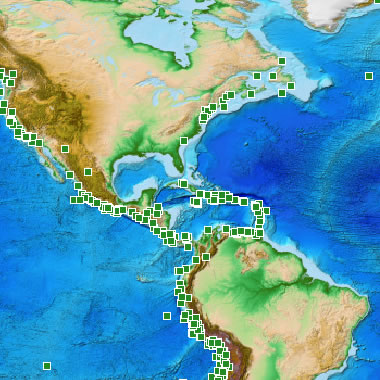
NOAA Tsunami Reports Map (from Geology.com)
| NOAA Tsunami Reports Map |
| The National Geophysical Data Center has an online database of tsunami reports that can be accessed through an interactive map. The image above shows locations of reported tsunami observations along the eastern United States and through the Caribbean. If you visit their interactive map website you can query any point shown above for more information. NOAA image. |
Monday, August 23, 2010
Abstract book (45th Annual Meeting of the Northeastern Section, GSA)
It is available on our web site the abstract of
45th Annual Meeting of the Northeastern Section, GSA
59th Annual Meeting of the Southeastern Section, GSA
Sheraton Baltimore City Center
Baltimore, Maryland, USA
14–16 March 2010
www.geosociety.org/sectdiv/northe/2010mtg/
45th Annual Meeting of the Northeastern Section, GSA
59th Annual Meeting of the Southeastern Section, GSA
Sheraton Baltimore City Center
Baltimore, Maryland, USA
14–16 March 2010
www.geosociety.org/sectdiv/northe/2010mtg/
2011 Sediment Microbiology Meeting
Next Meeting:
Microbiology in Marine Sediments
Theme: Microbiology in marine sediments
Date: 2011 March 6-9
Host: University of North Carolina (UNC)
Organizers: Andreas Teske - chair (UNC),
Jen Biddle (University of Delaware),
Matt Schrenk (East Carolina University)
Scientific Conference: The theme of the UNC meeting will be the application of novel culture-independent and culture-dependent microbiological methods to marine sediments and their pore fluids. By necessity, research in this arena often focuses on enumerating cells and cataloging phylogenetic diversity. In the coming years, however, more emphasis will be placed on the active components of microbial communities and the expression of functional genes. Accordingly, to diminish misleading DNA signals from lysed and inactive cells, the more labile RNA molecules, which occur in proportionally greater numbers in active cells (Sørensen and Teske 2006), can be targeted through both molecular and microscopic techniques. The standardization of molecular (DNA and RNA-dependent) techniques, and development of consistent protocols in sample handling and analysis become increasingly important as divergent results from different groups and teams require cross-checking and reconciliation (Schippers et al. 2005 vs. Lipp et al.). Although sequencing capabilities and costs permit ever-growing genetic databases and an ever-growing dependence on such data, culturing efforts are also experiencing a scientific renaissance. As an example, the American Academy of Microbiology recently reported that "most environmental microorganisms have yet to be isolated and identified, let alone rigorously studies", and that research and technology must help overcome the barriers that prevent the study of uncultivated microorganisms (Harwood and Buckley 2008). Culturing efforts must target individual species and microbial communities, as well as the "effects of perturbation" on these communities.
Education workshop: The training workshop at this meeting will highlight methods for extracting genetic material from sediment, porewaters, and hydrothermal fluids; the development of nucleotide primers for functional gene analysis; advances in cultivating novel and dominant members of microbial communities; and ways to control for seawater contamination in sediments and associated fluids. First, new methods for analyzing deep subsurface communities based on 16S rRNA, instead of 16S rRNA genes (i.e. DNA), will be made available to the DEBI community through lectures, tutorials, and lab exercises; examples include extraction and analysis of 16S rRNA, instead of 16S rRNA genes (i.e. DNA), and rRNA-tag or randomly primed high-throughput pyrosequencing techniques (Sogin et al. 2006; Huber et al. 2007). Second, expertise in practical aspects of molecular surveys of deep-subsurface communities will be shared. One obvious example of many is primer development and functional gene analysis; published generic primers are frequently insufficient for deep subsurface studies due to lineage-specific mismatches and inherent bias (Teske and Sorensen 2008), and due to decreased sensitivity owing to lineage-specific nucleotide ambiguities; using multiple, lineage-specific primers allow much more comprehensive analysis of deep subsurface functional gene cohorts (Lever and Teske, 2007). Third, novel approaches for the enrichment of specific functional and phylogenetic groups will be discussed and also demonstrated as much as feasible. The approaches include sediment microcosms, stable isotope probing, and in situ colonization experiments. New culturing efforts are relying more heavily on solid substrates, non-traditional redox pairs, micronutrients, chemical gradients, and symbiotic relationships. Fourth, contamination monitoring with chemical tracers will be taught. An approach pioneered by Smith (Smith et al. 2000) and House (House et al. 2003), and developed further on IODP leg 301 to the Juan de Fuca Ridge flanks, can now be applied in microbial community analyses of deep sediments continuing into basement basalt (Lever and Teske 2007).
Application and registration information is forthcoming.
Subscribe to:
Posts (Atom)